One ZIP File. One Empty Wallet. Why Your Threat Model Must Include the Tools You Trust.
How a Trojan.Dropper turned a Samsung FRP tool into a $3M XMR heist — and what your setup should look like instead

The attack vector wasn’t the malware. It was the machine.
Published by NULL_ROUTE | cetoc.org
There is a pattern in how people lose crypto. It is rarely a flaw in the protocol. It is rarely a sophisticated zero-day. In the vast majority of cases, the attack vector is a file the victim chose to run — on the same machine where the wallet lived.
The SamFW case is one of the clearest documented examples of this pattern in 2026.
What Happened
A Samsung FRP (Factory Reset Protection) bypass tool called SamFW Tool has been flagged as distributing Trojan.Dropper malware. According to reports filed on Bitcointalk, a victim installed SamFwToolSetup_v5.4.zip from samfw.com and lost their entire Feather Wallet balance — approximately 10,000 XMR — within hours of installation.

Key technical findings, documented publicly:
Malwarebytes analyzed the installer and identified a Trojan.Dropper payload:
C:\1\1\1\SAMFWTOOLSETUP.EXEVirusTotal flagged version 5.4 across multiple engines — classifications include Trojan, PUA, and heuristic detections
The file contained a fake timestamp set to year 2097 — a known anti-forensics technique
The tool refused to run in VirtualBox and sandboxed environments — by design
Version 5.4 was deleted from the official site shortly after the theft, replaced with 5.5
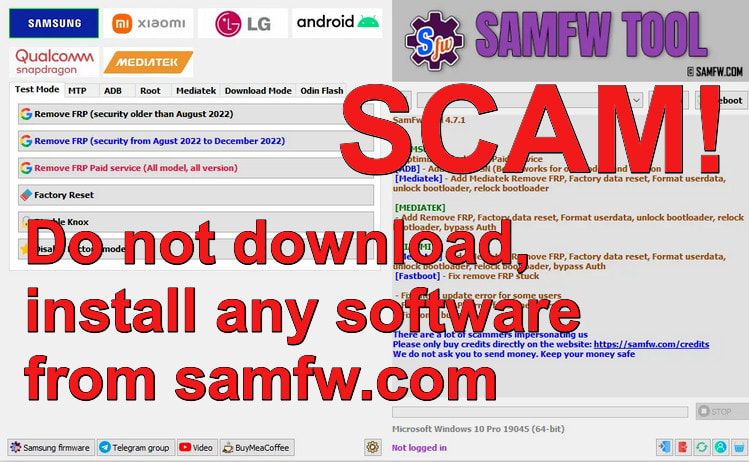
A Trojan.Dropper does not steal data directly. It installs the tools that do. After execution, it can deploy keyloggers, infostealers, clipboard hijackers, and remote access trojans — silently, without user interaction.
The victim reported losing mouse control, being unable to open Task Manager, and watching files disappear in real time.
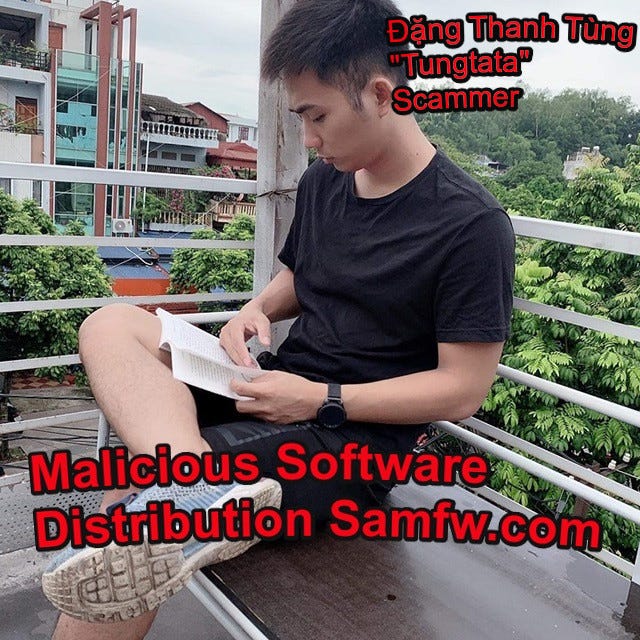
The Red Flags Were Visible
This is not hindsight. The warning signs were documented and searchable before the incident.
“Disable your antivirus to run this tool.”
This is not a workaround. This is the attack vector. Legitimate software that handles device communication (Chimera, Z3X, UnlockTool) does ship with some AV flags — but no legitimate tool requires you to disable protection entirely to function.
The tool refused to run in a VM.
Android servicing tools can have USB/driver limitations in virtual environments. But a tool that specifically detects sandbox environments and refuses to execute is exhibiting behavior associated with malware evasion, not hardware compatibility.
Fake timestamp: 2097.
Executables have compile timestamps. A timestamp set 70 years in the future is a deliberate anti-forensics move — it breaks timeline analysis and confuses automated detection systems.
VirusTotal detections dismissed as “false positives.”
SEO content promoting the tool consistently described AV detections as false positives. Some detections in this category are false positives. But when the detection label is Trojan.Dropper — not PUA or Riskware — and the tool refuses to run in isolation, the false positive explanation requires scrutiny.
The Actual Opsec Failure
The victim’s opsec failure was not installing suspicious software.
It was installing any software on a machine that held an active wallet.
This distinction matters. Even legitimate software can be compromised. Supply chain attacks, hijacked update servers, and bundled installers have all been used to target crypto users. The threat model for a machine holding significant funds is not “avoid obviously malicious software.” It is “assume that any software installed on this machine could be a vector.”
One machine. One purpose. No exceptions.
What a Correct Setup Looks Like
This applies directly to the privacy stack — VPS, VPN, wallet management, privacy tools. The principles are identical.
Dedicated wallet machine
A device used for holding or accessing crypto does not run browsers, download tools, or connect to anything beyond what the wallet requires. Ideally: air-gapped, or Tails OS booted from USB with no persistent storage.
Separate environment for everything else
Phone unlocking tools, browser extensions, VPN clients, productivity apps — these belong on a different machine or in an isolated VM. Not on the wallet machine.
Verify before you execute
SHA256 hash verification against the publisher’s signed release. GPG signature check where available. If the publisher does not provide a signed hash, that is a signal.
Test in isolation first
Tools that require device access (USB, ADB, drivers) can be tested in a VM with USB passthrough. If the tool refuses to run, that is not a compatibility note. That is a data point.
Clipboard is an attack surface
Clipboard hijackers swap wallet addresses at the moment of paste. Every address, every time: verify character by character after pasting.
Seed phrases are offline
Written on paper. Stored physically. Never typed into any online environment, never stored in a file on any connected machine.
Why This Matters for Privacy Users
The privacy and XMR community is a specific target. Wallets holding XMR are not trivially traceable after the fact — which means recovery is near-impossible. A $3M theft in XMR leaves almost no on-chain trail. The attacker knows this.
Tools targeting this community are unlikely to advertise themselves as malware. They will present as legitimate utilities — FRP bypass tools, trading bots, firmware flashers, VPN clients — with real functionality and real users who experienced no issues. The payload activates selectively, on machines where something valuable is present.
The SamFW case documented this explicitly: users with nothing sensitive on their computers reported no problems. The tool appears to function normally for them.
That is the design.
The Rule
If a tool requires you to lower your defenses, runs only on your main machine, and cannot be verified through a signed hash — it does not belong on any machine that holds funds, seeds, or credentials.
One environment for tools. One environment for assets. Never the same machine.
NULL_ROUTE is a privacy-first project. We maintain a curated directory of no-KYC crypto services, a privacy swap aggregator, and operational security resources at cetoc.org.
This article references the ongoing Bitcointalk thread: Samfw.com Scam – Fraud & Trojan RAT Malware : SamFWTool Theft (XMR)